In 2024, Globally Childhood Pneumonia claimed lives of over 800,000 children under the age of 5, that is one child every 39 seconds. Childhood Pneumonia is the second largest cause of infectious deaths among children below 5 years. Child deaths from pneumonia are concentrated in the world’s poorest countries. Within these countries, it is the most deprived and marginalised children who suffer the most. They often have limited or no access to basic health services and are more likely to suffer from other health threats like malnutrition, infectious diseases and polluted air. They often live in fragile or humanitarian settings, where often risk factors increase and health systems break down.
ZThe two most important reasons to avert Childhood Pneumonia deaths in low-resource settings is creating awareness about causes and symptoms and access to screening & early diagnosis in low-resource settings. Chest radiography is not available in low-resource settings. Radiography it can be expensive to upkeep, and does not provide information about the causes of the pneumonia. This problem is further exacerbated by the increasing recognition that childhood pneumonia is multi-pathogenic. Also for children below 6 months (especially 0-2months) it is difficult to perform chest radiography.
SOLUTION
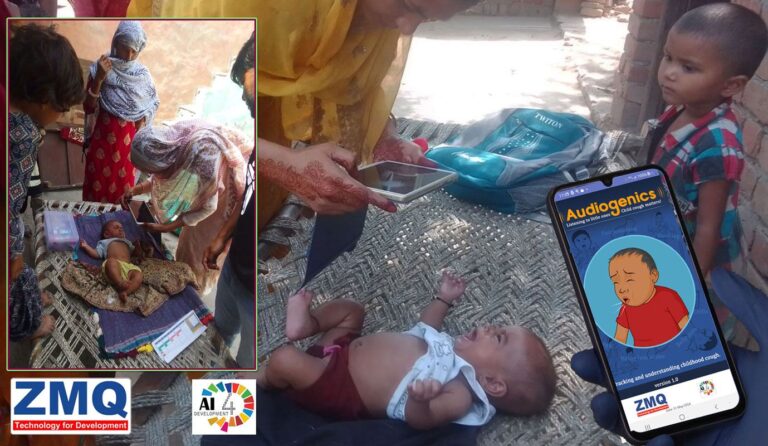
ZMQ Globalalong with its AI4Dev Lab atZMQ Developmenthas developed a new AI based toolkit – AudioGenics, using Deep Learning Algorithms to diagnose Childhood Pneumonia, especially in children below 0-2 months and 2-12 months.Audiogenics captures crying, coughing and talking voices of neonatal. The toolkit is able to identify cases of Pneumonia and Severe Pneumonia Bacterial Infection (PSBI) with over 82% accuracy.
IMPLIMENTATION STAGE
ZMQ teams are running a study in Nuh District, Mumbra-Kausa in Thane, Shravasti in Uttar Pradesh and Jehangir Puri in Delhi though our field teams and ASHA workers. We are working to improve its accuracy of diagnosis from 82.3% (with 5000 training data) to over 95% (with over 50,000 training data) in next 6 months.